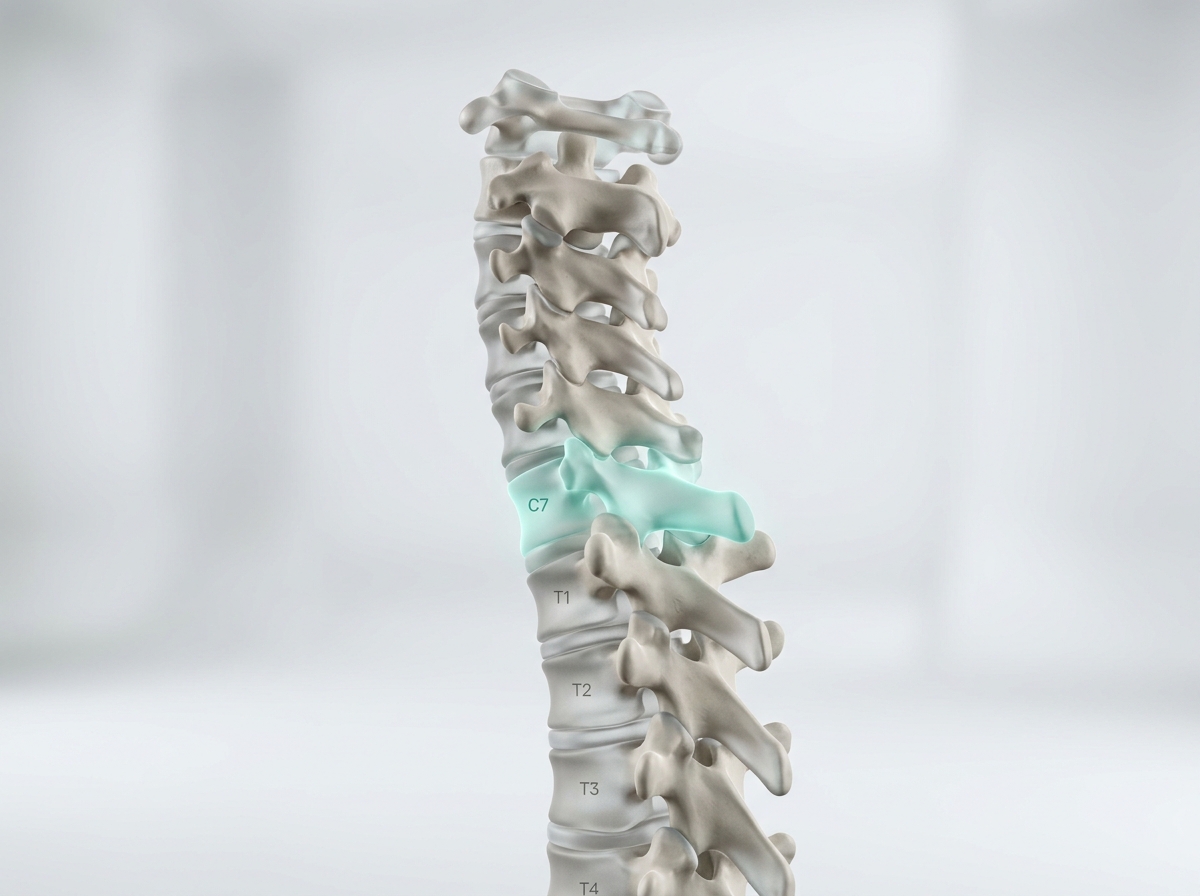
The short answer is that these words describe different concepts, but they are not two reliable categories you can assign from a picture. A visible prominence is a reason to ask what you are noticing, not a conclusion about the tissue underneath it. NeckCheck cannot distinguish a fat pad from a spinal curve, assess bone strength, or explain a new lump.
Search results often put older phrases such as “buffalo hump” and “dowager’s hump” beside one another as though a quick visual comparison can settle the question. Here, those phrases are used only to help you find an explanation. Neutral descriptions such as “neck prominence,” “upper-back curve,” and “head position” are more useful for discussing what you have actually noticed.
Three concepts, rather than two photo classes
Head position and CVA
The craniovertebral angle is formed by a horizontal reference through C7 and a line from C7 toward the tragus at the ear. In this tool, both locations are image estimates that the user must confirm. That geometry describes a relationship between points; it contains no direct information about the tissues forming the outline. See the measurement explanation and research limits.
Upper-back curvature
“Dowager’s hump” is an older everyday expression commonly used for a rounded upper back. The more specific clinical discussion concerns thoracic curvature. The NHS kyphosis overview explains that upper-back rounding can have different causes. CVA is not the angle used to measure that curve, and this site cannot classify it from a silhouette.
A dorsocervical fat pad
This term describes fat accumulation at the back of the neck. MedlinePlus explains that a prominence alone does not establish a specific condition and that an unexplained one should be assessed. A name found online does not tell you whether it applies to your body.
These concepts should not be forced into a binary quiz. Choosing “posture” in a menu would not exclude other concerns; choosing “fat” would not make head position irrelevant. The safe limit is to describe each concept and leave individual assessment to someone who can take a history and examine you.
A comparison for understanding, not self-classification
| Question | Head position / CVA | Upper-back curvature | Dorsocervical fat pad |
|---|---|---|---|
| What is being described? | A relationship between head and neck landmarks | The curve of the upper spine | Fat accumulation behind the neck |
| What does NeckCheck measure? | An estimated angle in one side-view image | It does not measure this curve | It does not identify or measure this tissue |
| What information matters? | Photo setup, point placement and the limited purpose of the measurement | A clinical history and examination; further tests when appropriate | A clinical history, medicine review and examination; further tests when appropriate |
| What is a sensible next step? | Understand the limitations; put symptoms first | Discuss a concerning or changing outline with a clinician | Discuss an unexplained prominence with a clinician |
There is intentionally no row saying that a soft area must be fat or a firm area must be bone. There is also no rule that a contour disappearing in a different pose makes it harmless. We have not established a reliable home touch or movement test for those conclusions. A simplified chart should make the limits easier to see, not conceal uncertainty behind confident labels.
The same caution applies to somebody else’s comparison photographs. Different lighting, clothing, camera positions and ways of standing make an appearance comparison a poor basis for a personal conclusion. You do not need to copy a pose, push the head toward a wall, or submit photographs to strangers for classification.
What a clinician may consider
A useful conversation starts with what changed, when you noticed it, and whether you have symptoms or changes in everyday function. You can explain your concern without arriving with a condition name. A clinician can decide which parts of your history and examination need closer attention, rather than relying on an angle or internet checklist.
Medicines and hormonal conditions may be relevant in some assessments. The NIDDK overview of Cushing’s syndrome explains that prolonged excess cortisol or glucocorticoid exposure can be associated with a cluster of changes, including fat around the neck. That association does not establish a hormone problem from appearance. Do not change prescribed medicines yourself or buy a hormone test or supplement based on a photograph.
Bone health is a separate question. NIAMS explains that osteoporosis can be silent before a fracture and that spinal fractures can accompany back pain, height loss or a more stooped posture. These facts do not let NeckCheck identify or exclude either concern. Mention relevant changes and history to your clinician rather than using the photo angle as reassurance.
Tests are not a standard shopping list for every neck outline. Ask what question an examination, scan or laboratory test would help answer and how its result might affect the next step. American Family Physician’s assessment review describes evaluation guided by history and findings. It does not make every reader a candidate for the same investigation.
Useful notes to bring to an appointment
You can make a short private note for yourself. It need not contain a photograph or an angle. The following prompts organize a conversation; you do not need to answer all of them before asking for help:
- When did I first notice the change? Was the timing sudden, gradual or unclear?
- What is changing now: the outline, comfort, movement, sleep, or something I do each day?
- Have I had an injury, previous spinal problem, surgery or a relevant medicine change?
- Have I noticed new arm symptoms, walking or balance problems, fever, unexplained weight change or persistent night pain?
- What would I like help with first, and what do I want to understand about safe activity?
Bring an up-to-date medicine list if you have one. You can say “I’m unsure when this started” instead of guessing a date. If a symptom needs urgent attention, do not postpone contact while completing the note. This website has no appointment form and does not need you to send it these personal answers.
Why an angle cannot answer a tissue question
Imagine two dots on any image and a horizontal line. Moving either dot changes the angle even if the image itself stays the same. The calculation can report that change, but it cannot discover what lies below the image’s surface. In NeckCheck, moving a marker may change the result without any change in the person at all.
That is why a number near a reference value cannot settle your concern. Nor does a lower number identify a cause or select a suitable exercise. The methodology page separates exact angle arithmetic from uncertain anatomy and photo setup. A successful calculation is not proof that the right anatomical points were marked.
Safe next steps
Arrange an assessment for an unexplained or changing prominence, especially when it comes with symptoms. Do not delay that conversation to complete a multiweek exercise challenge. Keep prescribed medicines unchanged unless your prescriber advises otherwise. There is no requirement to prove that something is painful enough before raising a concern.
If no warning symptoms apply and you want general movement ideas, our posture-habits guide explains the limits and stopping conditions for optional examples. It does not promise tissue change or reverse a spinal curve. Choose help based on your questions and circumstances, rather than making the appearance of a photo the sole goal.
Common questions
Can posture exercises remove a fat pad?
These pages do not establish that. A movement routine is not a way to identify tissue or choose care for an unexplained prominence. Discuss the concern and suitable activity with a clinician.
Does an angle near the reference mean nothing is wrong?
No. The angle describes two estimated points in a picture. It does not rule out a medical concern, explain symptoms or establish the cause of a visible contour.
Will I need a scan or blood test?
That depends on the clinical history and examination. An online appearance comparison cannot determine which tests, if any, are appropriate. Ask what a proposed test is intended to answer.
Can I decide by touching or moving the prominence?
This site provides no reliable home touch test for separating fat from bone or other tissue. Do not repeatedly press, pinch or manipulate the area to assign yourself a category.
Sources and review status
Sources linked above support the definitions, clinical context and assessment principles beside them. They do not establish a home tissue-identification rule or endorse NeckCheck. The comparison, wording and safety guidance remain DRAFT pending professional review. The editorial update date is not a clinical-review date.
- MedlinePlus: dorsocervical fat pad (2025 review). Definition and clinical assessment, not a home classification rule.
- NHS: kyphosis overview (2025 review). Upper-spine curvature is distinct from CVA.
- NIDDK: Cushing’s syndrome overview (2018 review). Clinical context; appearance does not establish a hormone condition.
- NIAMS: osteoporosis overview (date not established). Bone-health context; posture photographs cannot assess bone strength.
- Childress and Stuek: clinical neck-pain evaluation (2020). History and examination guide assessment and testing.
Source links checked during draft preparation on 2026-10-03. Some research details were verified through publisher-indexed text or institutional records when direct pages were unavailable. Human source and applicability review remains pending.