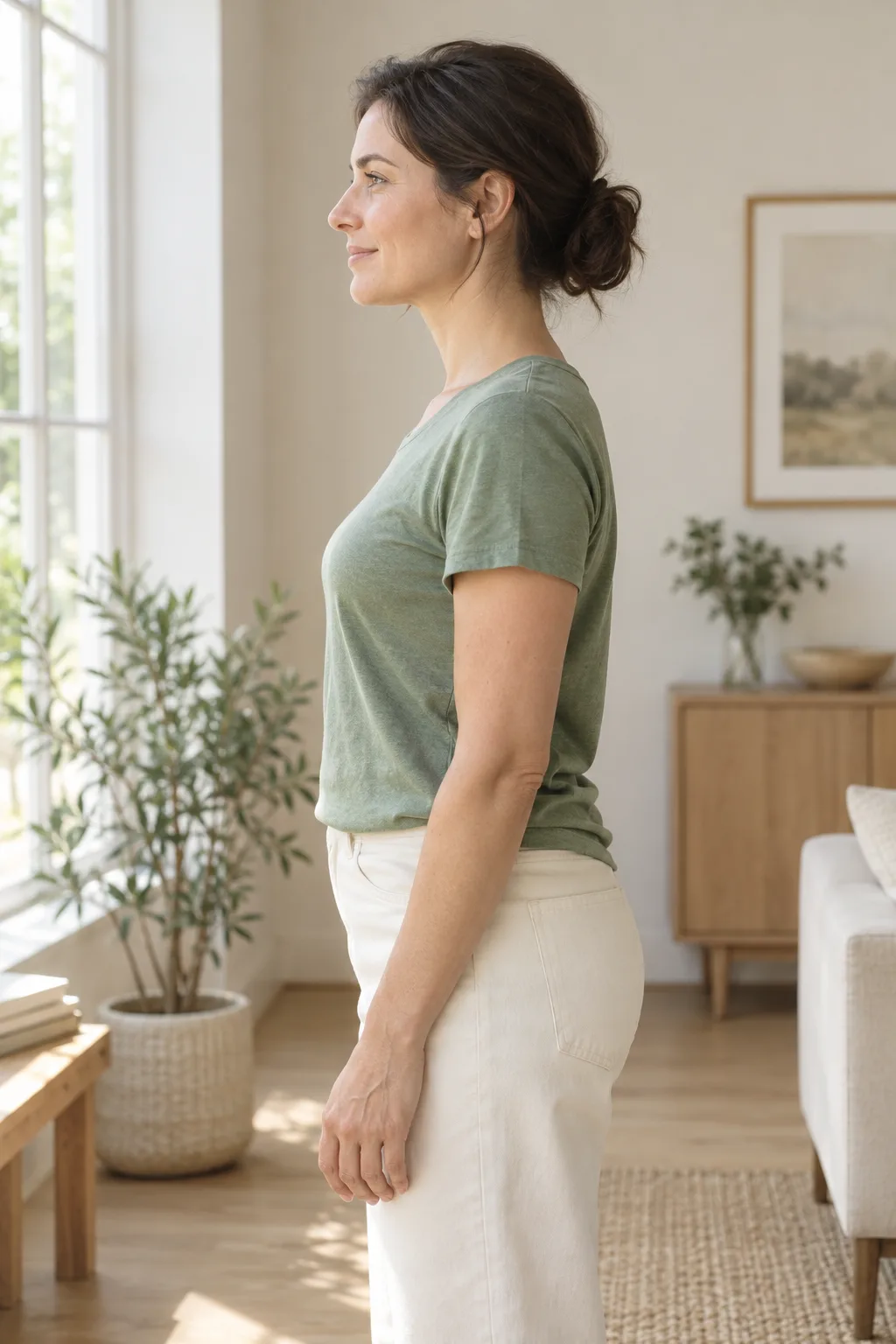
NeckCheck is a draft educational tool for estimating a craniovertebral angle, or CVA, from a side-view image. It is a two-point angle calculation with an assisted marking interface. It is not a measurement of a neck lump or upper-spine curve. There has been no clinical validation of NeckCheck’s self-marked workflow or its accuracy.
The angle, in plain language
The reference is a horizontal line through a point intended to represent the C7 spinous process. The second line runs from that point toward the tragus, the small cartilage prominence at the front of the ear opening. CVA is the angle between those lines. The definition is used in the 2024 reference study cited below.
Explore the two-point CVA angle
Change an illustrative angle between a horizontal line at C7 and a line to the ear marker. These are geometric examples, not personal measurements or recommended postures.
CVA describes the angle between two marked points and a horizontal reference. A smaller angle moves the example ear point further forward along this fixed-length ray.
This schematic does not estimate force, weight, tissue stress, symptoms or health. It cannot establish whether a posture is safe or whether a neck prominence needs care.
Use a synthetic test image in this development preview, or try the photo-free wall check.
Educational geometry only. The diagram is simplified and is not a validated anatomical, biomechanical or medical model.
For the same image and marked points, the arithmetic is deterministic. A smaller angle indicates a more forward-inclined connecting line relative to the image’s horizontal. That observation does not establish why the points are positioned that way, whether someone has pain, or whether an exercise is appropriate.
The calculation first converts normalized image coordinates into pixels using the image’s actual width and height. It accounts for whether the person faces left or right. It then uses the horizontal and vertical separation of the two points to compute the angle. It does not convert pixels into millimetres: a single photo without a scale cannot supply that distance.
What the model guesses, and what the user confirms
MediaPipe Pose Landmarker supplies general body landmarks such as ears and shoulders. Its published landmark list does not include C7 or a precise tragus point. NeckCheck therefore uses these landmarks only as references for initial marker guesses. It does not automatically locate C7.
The user must inspect and adjust the ear and C7 markers, then confirm them. Confirmation means “these are my best estimates,” not “the anatomy is verified.” Hair, a collar, an oblique view or uncertainty about the neck point may make an estimate unsuitable. The most visible bump is not necessarily a reliable C7 locator. If you cannot identify a point, skip the number rather than forcing a placement.
The intended sequence is: read the safety/privacy notice; choose the photo path; load same-origin model resources; decode the image in browser memory; obtain initial pose landmarks in a Worker; inspect and adjust the two points; run quality checks; and show an eligible estimate with limitations. Inference failure must not silently move model work onto the main interface thread.
Photo setup matters
The draft capture convention is a comfortable standing side view, with the head through hips visible, the camera level at approximately shoulder height, and roughly two to three metres of space when practical. Avoid deliberately pulling your head back to change the output. Keep the ear and neck area visible without removing clothing beyond your comfort.
This is a product capture convention awaiting validation. It is not a reproduction of every published research protocol. Camera roll changes the horizontal reference. A partly front-facing image projects three-dimensional anatomy differently from a side view. Cropping, clothing, posture at that moment and marker placement can also change the estimate. The product has not established a numerical error allowance for these effects.
Consistency may make two photographs easier to compare, but it cannot make uncertain landmarks certain. A rounded display number does not mean that a one-degree difference is meaningful. Taking repeated pictures until a preferred number appears would change the question from observation to selecting an outcome.
What the cited studies actually establish
A 2024 reference sample
Zárate-Tejero and colleagues measured 122 adults and reported a mean CVA of 48.76°, with a standard deviation of 6.77°. Their protocol used supported sitting, a shoulder-height camera one metre away, and physical C7 marking. The sample mean is not a universal standing-photo target. It does not validate NeckCheck or establish a personal healthy range.
A 2023 application study
Carrasco-Uribarren and colleagues evaluated another application with trained assessors and physical C7/tragus markers, comparing measurements with Kinovea. Its results concern that system and protocol. They do not establish the reliability of an automatic C7 guess, unassisted self-marking, or this tool. A study-specific detectable-change statistic cannot be reused as this product’s accuracy.
A 2010 photogrammetry thesis
Inae Camargo Gadotti’s University of Alberta thesis describes standardized photographs and radiographs in 39 healthy women, reporting correlation of 0.84 for the relevant CVA comparison. Correlation is not “84% accuracy,” exact agreement or evidence about all populations. That study did not assess NeckCheck.
These sources motivate explaining photographic geometry carefully. Their authors have not reviewed this product. Public-source checking is not clinical review. No result from a different study removes the need to validate this implementation and the people, camera setup and marking workflow in which it would be used.
Reference labels and uncertainty
The draft interface has configurable boundaries around 50°, 45° and 40°. They are provisional interface heuristics, not medical severity grades or universal normal ranges. They must not be used to infer a condition, select care or dismiss symptoms. A clinician’s approval of cautious wording would not by itself validate those boundaries.
No product-specific evidence supports a ±5° accuracy claim. A stored proposal for such a range is not a measured confidence interval or a maximum personal error. The interface must communicate unvalidated uncertainty without turning that proposal into a precise promise. A future calibration study would require suitable consent, a defined protocol and a transparent report; none has been completed.
When the tool should refuse a result
Missing pose references, invalid or coincident coordinates, an implausible neck-point placement, or an angle outside the supported interval must block a number. Depending on configured quality rules, an unsuitable side view may also block it. A person can reposition markers, retake an appropriate photo, or stop. A lower-confidence label is not permission to bypass a hard check.
Other warnings concern resolution, obscured ears, framing, multiple people and the camera’s unconfirmed level. Passing these engineering checks still does not prove anatomical correctness. A warning symptom takes priority even if every numerical check passes.
The optional wall questionnaire concerns comfort and reported position only. It produces a category and general next-step information, never a numerical posture score. Its hold-time categories are unvalidated product heuristics. A comfortable category does not rule out a medical issue.
Privacy and technical boundaries
The design keeps selected image data and results in browser memory, loads model files from the same site, and supplies no upload, public-link or photo-export feature. Local Chromium and Firefox tests with a fictional image provide bounded evidence of inference, same-origin loading and resource cleanup. Photo initialization and strict Worker checks remain unsuccessful in the tested Windows WebKit runner; real-device testing and independent privacy review are still pending. These tests do not establish an end-to-end privacy promise for every browser or physical memory erasure. Do not use real personal health photos in this development version.
The current candidate is MediaPipe Tasks Vision 0.10.35. Source inspection did not find the telemetry chain identified in rejected candidate 1.0.1, but that is not a network observation. The upstream notice describes performance/usage metrics. Read the release-specific privacy disclosure for the distinction, storage limits, hosting context and remaining checks.
Related information and changes
For the question “what is this outline?”, read the different neck-prominence concepts. For general activity ideas, read the movement guide’s safety limits. You can return to the tool overview without measuring yourself.
2026-10-03: First editorial draft of the method, protocol-specific source summaries and validation limits. The interface uses Astro and Preact; the pose SDK is MediaPipe, distributed under Apache-2.0. Citations identify research, not product endorsement. Publication, editorial source checks, calibration and runtime privacy verification remain pending.
Sources
- Zárate-Tejero et al.: CVA reference values (2024). Supported sitting with physical marking; not a standing-photo norm.
- Carrasco-Uribarren et al.: a different CVA application (2023). Trained raters and physical markers; not NeckCheck validation.
- Gadotti: sagittal craniocervical photogrammetry thesis (2010). A standardized 39-woman study; correlation is not product accuracy.
- MediaPipe: Pose Landmarker (accessed 2026-10-03). Landmark definitions; C7 is not a model landmark.
- MediaPipe: upstream privacy notice (2026 revision). General input and metrics disclosure; release behavior still needs tests.
Source links checked during draft preparation on 2026-10-03. Some research details were verified through publisher-indexed text or institutional records when direct pages were unavailable. Human source and applicability review remains pending.