
There is no single exercise routine that answers every concern described as a “neck hump.” Before trying to change an outline in a mirror, separate the questions: Are you noticing head position, the curve of your upper back, a new prominence, discomfort, or a combination? Those questions need different kinds of information. An exercise illustration cannot tell you which applies to you.
This guide offers a way to organize those questions, practical ideas for a more comfortable day, and five movement examples to discuss with a clinician when appropriate. It does not promise a change in appearance or prescribe a programme from a photograph. You do not have to earn a particular posture, angle or silhouette to deserve help with pain or worry.
What people may mean by “neck hump”
Head position is one concept. The craniovertebral angle, or CVA, describes the angle between a horizontal line through an estimated C7 point and a line toward the ear’s tragus. This is the limited geometry that NeckCheck explores. It is not a measurement of the upper spine’s curve. The 2024 CVA reference study describes the landmark-based measurement.
Upper-back curvature is another concept. The NHS overview of kyphosis describes a rounded upper back and explains that causes and assessment vary. A dorsocervical fat pad refers instead to fat accumulation behind the neck. MedlinePlus advises discussing an unexplained prominence with a healthcare professional. A photograph does not sort these concepts into a reliable personal answer.
It is reasonable to describe what you have noticed without choosing a label. “I noticed this outline recently” or “turning my head feels uncomfortable” gives a clinician a starting point. You do not need to press on the area, compare yourself with someone else’s picture, or decide whether a shape is “good” before asking a question.
Before a self-check or new movement
Use the warning-sign guidance above first. A symptom that needs assessment should not become a challenge to complete an exercise. If you have osteoporosis, a previous spinal fracture or surgery, a relevant spinal condition, a recent injury, or a painful or limited shoulder, get individual advice before adopting these examples. Mayo Clinic’s osteoporosis exercise guidance emphasizes an individualized approach.
The drawings are original, simplified illustrations, not instructions to match a body shape exactly. They cannot show how a movement feels. Keep breathing, choose a comfortable range, and stop for pain, dizziness, new numbness, tingling, weakness or worsening symptoms. Do not repeat a movement to see whether those symptoms disappear. Seek help according to the medical-help guide.
If you later use a photo check, do not deliberately pull your head backward for a preferred number. Estimated points and camera setup affect the output. Not being able to identify a point is a valid reason to skip the measurement; guessing harder does not make it more dependable.
Five optional movement examples
These are examples from different educational sources, not one validated five-move routine. They are not selected for you by CVA. This page does not prescribe repetitions, hold times or a daily schedule. The examples and illustrations remain draft material for a separate scope and source check; individual exercise plans are outside this site's lifestyle purpose.
1. A small, level head glide
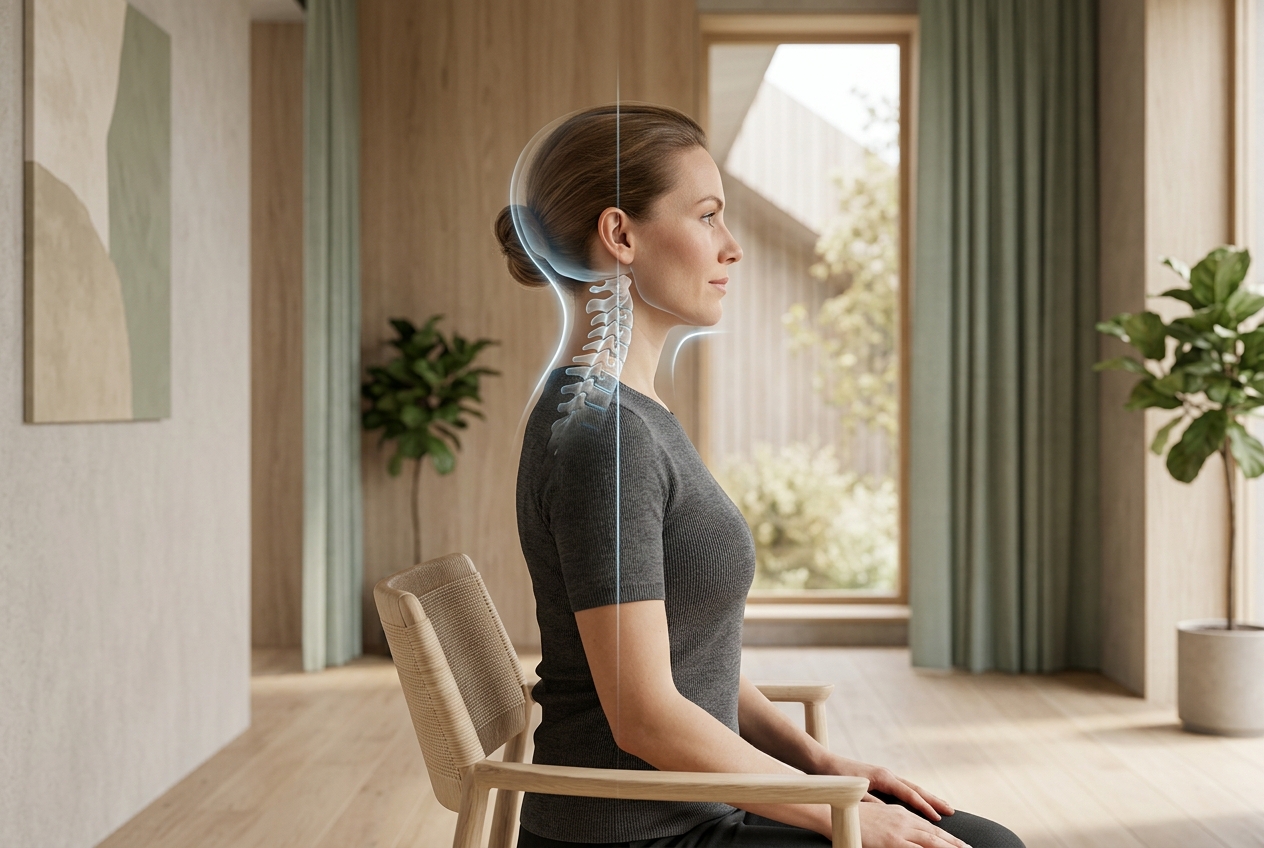
- Sit or stand comfortably and let your shoulders relax.
- Keeping your eyes level, gently glide your head backward a small amount. Think of a slide, not a downward nod.
- Return to the starting position without pulling on your jaw or neck.
A common error is lifting the chin or arching the back to make a larger movement. A smaller motion is not a failed attempt. Stop if the glide is painful, makes you dizzy or brings on arm symptoms.
Northwestern Medicine’s chin-tuck sheet describes this movement in its own educational context. Its instructions are not a personalized plan for this page's readers or evidence of a neck-contour outcome.
2. Comfortable wall-assisted arm movement
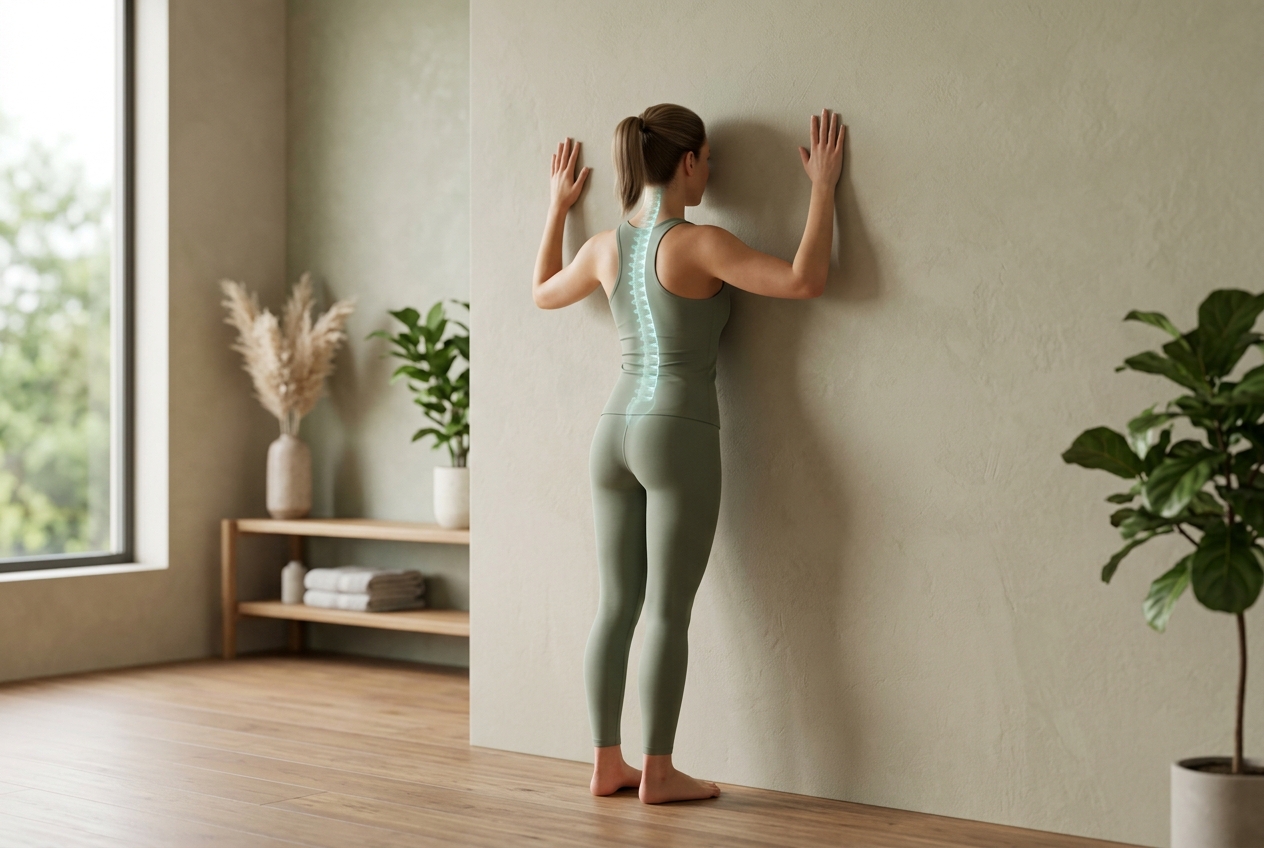
- Stand near a wall in a position that feels supported and easy to leave.
- Bend your elbows and slowly raise and lower your arms within a comfortable range.
- Keep the motion small if needed; do not force your wrists, back or head against the wall.
A common error is reaching higher by flaring the ribs or shrugging. Skip this example if your shoulder is painful or restricted, or if getting into position causes symptoms. You can stop without completing a particular shape.
Cleveland Clinic describes the movement; HSS discusses reducing the range, including keeping elbows at or below shoulder height. This page does not assign a repetition count.
3. A gentle doorway chest stretch
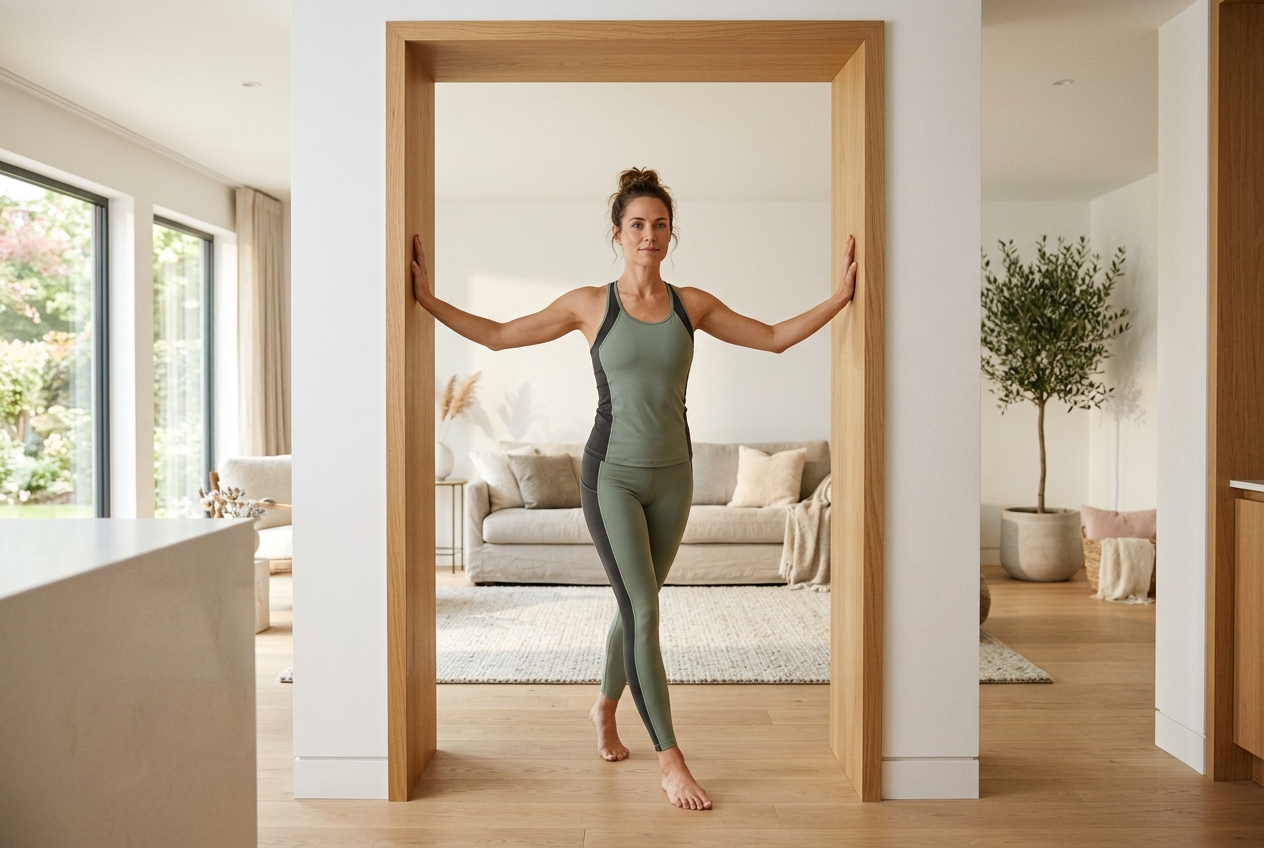
- Use a stable doorway, with your hands or forearms comfortably supported at or below shoulder height.
- Gently shift forward only far enough to explore an easy stretch across the chest.
- Ease back out while breathing normally; do not bounce or push your head forward.
A common error is placing the arms too high or leaning deeply to chase a stronger sensation. Stop for pain, tingling or any feeling of shoulder instability. If you cannot find an easy position, leave this example out rather than improvising a stronger stretch.
Cleveland Clinic’s shoulder-education example describes a shoulder-specific context. It does not establish a general routine for neck concerns; this page does not copy its timing or repetitions into a programme for readers.
4. Seated upper-back extension: discuss the setup first
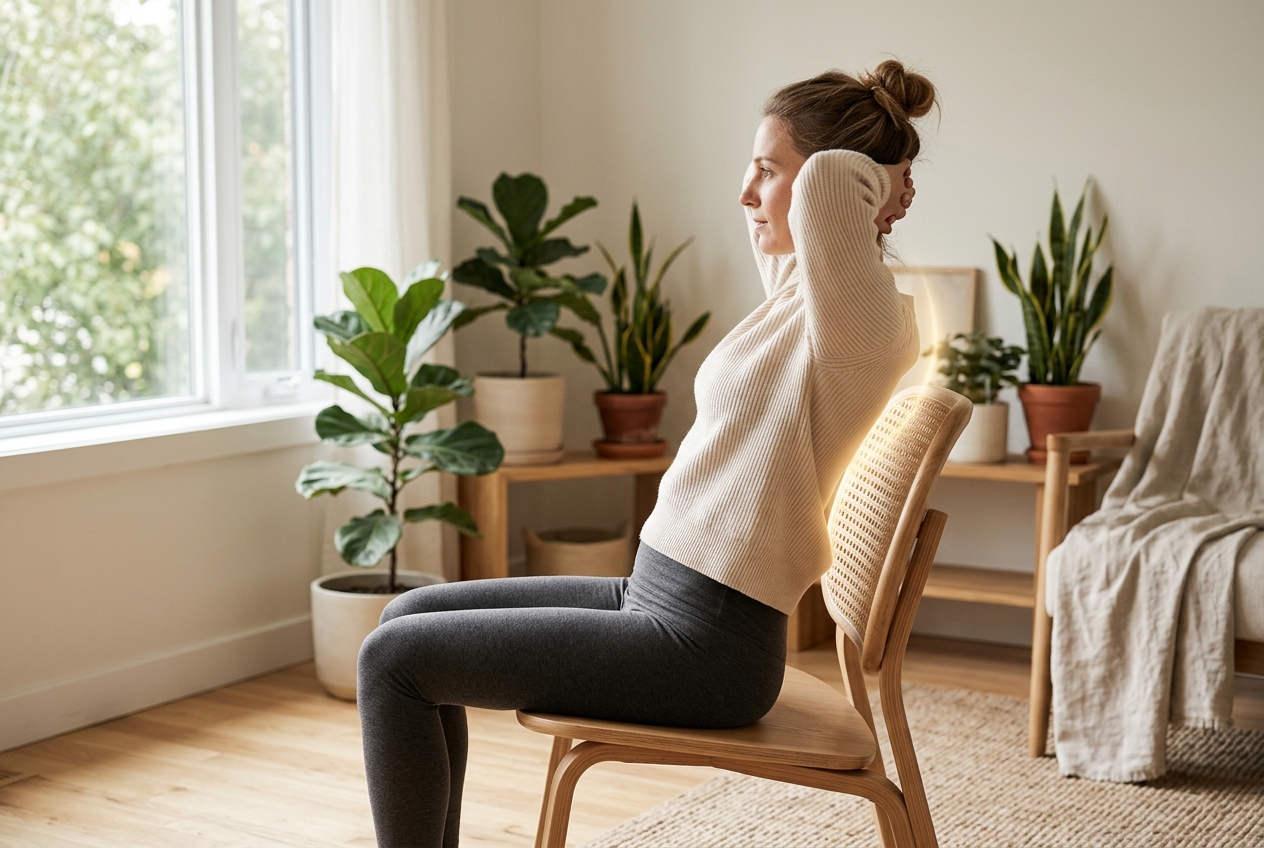
This example is deliberately conditional. The published OPAL seated-extension exercise uses a sturdy chair, supported feet and a controlled backward movement; it also includes looking upward. That source context does not establish that the same movement suits your neck or back. No repetition or hold schedule is provided here.
Ask a clinician whether this example, or a smaller supported alternative, is appropriate before trying it. Have them explain the chair position, neck position and comfortable range. Do not improvise by dropping your head back, rocking over an unstable chair or using a roller for more leverage. The final adaptation is still awaiting review. Skip it with unexplained back pain or without the individual guidance you need.
5. An unresisted shoulder-blade squeeze
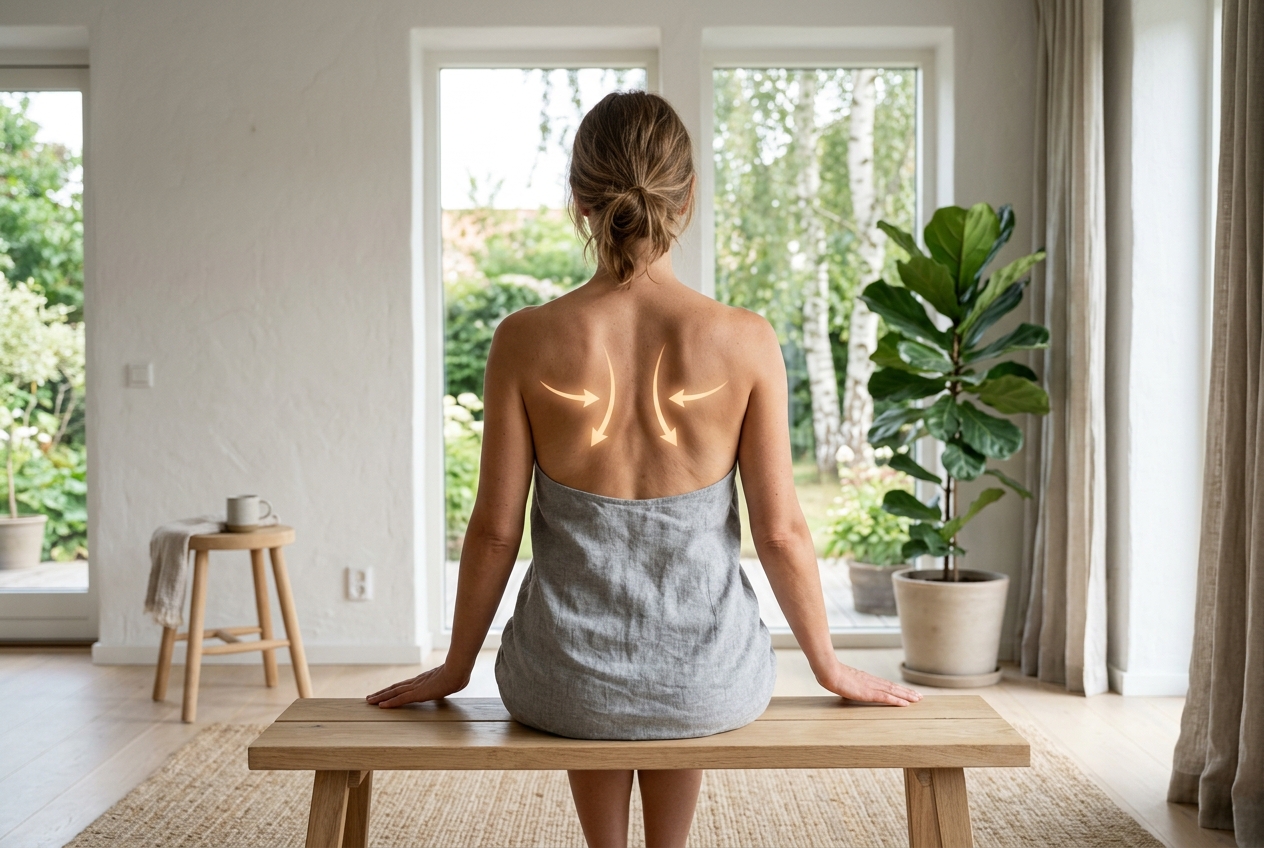
- Sit comfortably with your arms relaxed.
- Gently bring your shoulder blades a little closer together without lifting your shoulders.
- Release the effort and return to an easy resting position.
A common error is a hard squeeze paired with an arched lower back. Keep this an exploration of movement, not a strength test. Stop for neck or shoulder pain or arm symptoms. There is no need to add a band or anchor anything to a door to follow this illustration.
Mayo Clinic’s shoulder-blade example describes the movement. This page does not turn that example into a personal dose or daily schedule.
Make everyday tasks easier to vary
Start with a task that feels awkward rather than rebuilding your whole desk. Can you read the screen without leaning toward small text? Are the keyboard and mouse easy to reach? Can your feet and back rest comfortably? OSHA’s monitor guidance recommends a screen in front of you, its top at or below eye level, and a readable distance. Adjust text size as well as screen position.
OSHA also emphasizes changing position. A comfortable setup is not a position to hold rigidly all day. Use natural breaks between tasks to stand, walk or change what you are doing when it is comfortable. A reminder can help you remember a break, but a particular timer interval is not a proven dose for changing a neck contour.
For phones and reading, try supporting the device or your arms so the task feels easier; check that the new arrangement does not simply move the effort elsewhere. At night, think about comfortable head support rather than buying a product advertised around a photograph. The NHS neck-pain page advises keeping the head at a similar height to the body. Persistent sleep-disrupting pain deserves individual advice.
What would a useful change look like?
Choose an everyday question before choosing a number: Is working at the desk more comfortable? Can I vary tasks easily? Do I know which symptoms should prompt a call? Those are different questions from whether a contour has changed. You can write down your question and bring it to an appointment without keeping a gallery of comparison photographs.
No personal timetable for appearance change follows from these examples. The SHEAF trial studied a specific, supervised programme in older adults over six months. It concerned upper-spine curvature, not this five-example page or an individual CVA forecast. A research programme’s duration is not a countdown for you.
Common questions
Can these exercises remove a neck fat pad?
This page does not establish that. The examples concern movement, not tissue identification or targeted fat reduction. Ask a clinician about an unexplained prominence before choosing a plan.
Do I need to reach a CVA of 50 degrees?
No personal target has been established for this tool. Research protocols and populations differ. Its provisional reference labels are not a health grade or a reason to force your neck into a position.
Should I press my head against a wall?
No. A wall is an optional reference for comfortable movement. Do not force contact or tilt your chin upward to complete a check. Stop if the position brings on symptoms.
Do I need a special pillow or exercise equipment?
The examples here do not require a purchase. Choose comfortable support and get individual advice if sleep or movement is painful. A product cannot be selected from your angle result.
Sources and review status
Sources are linked beside the specific concepts or movement examples they support. They do not endorse NeckCheck or establish the accuracy of its tool. This lifestyle-scope revision is dated 2026-10-08; it is an editorial update, not clinical approval. Safety guidance, movement examples and illustrations need a separate scope and source check. This page does not prescribe exercise doses; the seated-extension adaptation remains withheld as a self-guided routine.
- Zárate-Tejero et al.: CVA reference values (2024). Supported sitting with physical marking; not a standing-photo norm.
- MedlinePlus: dorsocervical fat pad (2025 review). Definition and clinical assessment, not a home classification rule.
- NHS: kyphosis overview (2025 review). Upper-spine curvature is distinct from CVA.
- Northwestern Medicine: chin-tuck example (2024 review). Movement and source-specific count, not an individual prescription.
- Cleveland Clinic: posture movement examples (2024). Wall-angel description; a universal repetition count is not supplied.
- HSS: adapting wall-angel range (2024). Comfort modifications, not an efficacy estimate.
- Cleveland Clinic: doorway-stretch example (2021). Shoulder-specific education; not a universal neck programme.
- OPAL: seated thoracic extension (2023). Published sequence differs from the pending adaptation.
- Mayo Clinic: shoulder-blade squeeze (date not established). Unresisted movement example; no added-load guidance inferred.
- Mayo Clinic: activity with osteoporosis (2025). Individual safety advice matters.
- OSHA: monitor setup (date not established). Readable, adjustable workstation setup.
- OSHA: working positions (date not established). Support and variation, not a fixed medical timer interval.
- NHS: neck-pain self-care (2023 review). General support principles, not a pillow product claim.
- Katzman et al.: SHEAF trial (2017). A specific older-adult programme; not these five moves or a CVA forecast.
Source links checked during draft preparation on 2026-10-03. Some research details were verified through publisher-indexed text or institutional records when direct pages were unavailable. Human source and applicability review remains pending.