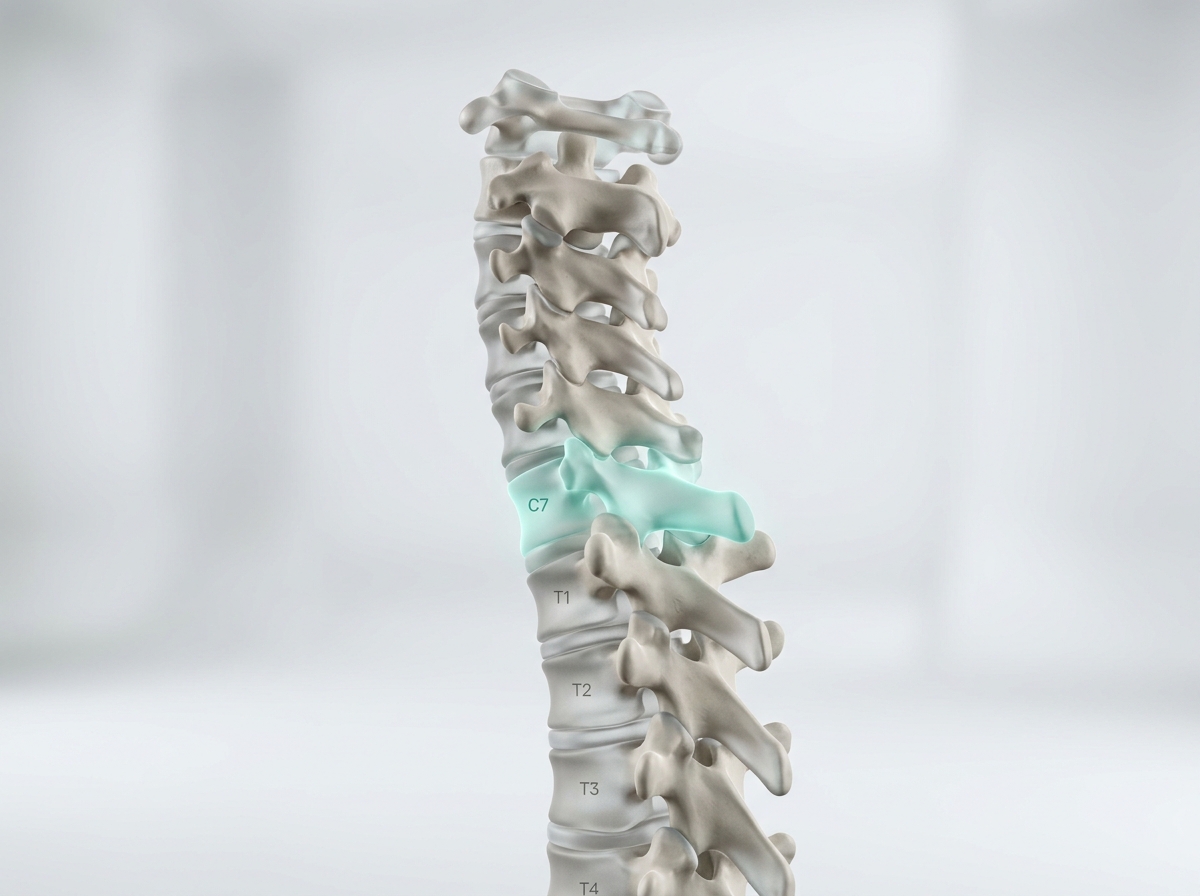
"How long will it take to go away?" is an understandable question when you notice a change at the base of your neck. There is no universal answer. Feeling more comfortable, moving more easily, and changing a visible contour are different goals. An exercise schedule or a photo angle cannot predict when, or whether, a particular prominence will change.
Why one timetable does not fit every concern
MedlinePlus explains that a prominence behind the shoulders does not by itself identify a specific condition. The NHS overview of kyphosis also describes different causes of an upper-back curve. These are reasons to seek an assessment when needed, not categories to assign yourself from a mirror.
| Concern | Useful question | Limit of a home observation |
|---|---|---|
| Head position in a photograph | Was the camera, stance, and marker placement consistent? | A changed angle is not a recovery timetable or an explanation for a prominence. |
| Soft tissue behind the shoulders | Does an unexplained change need a clinical assessment? | A photo cannot identify the tissue or its cause. |
| A rounded upper-back curve | What does an examination show, and what goals are appropriate? | CVA does not measure the spinal Cobb angle used in the study below. |
What the six-month SHEAF study actually tells us
The SHEAF trial by Katzman and colleagues included 99 adults aged 60 or older with hyperkyphosis. The programme involved supervised spine-strengthening and posture training for six months. Its main outcome was the Cobb angle measured on spinal radiographs, not the craniovertebral angle (CVA) estimated from a side photograph.
The exercise group had a greater average reduction in Cobb angle than the control group. That finding applies to the studied population and programme. It does not establish a six-month deadline for an individual, a sequence of weekly milestones, or the effect of a few unsupervised exercises on a neck prominence. It also does not validate NeckCheck as a way to monitor those outcomes.
How to assess a quick-fix claim
A claim to remove a neck prominence in seven days needs evidence about that specific outcome. The sources here do not supply it. Before following a plan, look for a clear explanation of who was studied, what changed, how it was measured, and whether there was a comparison group.
- Check the outcome: a report of comfort is not a measurement of spinal shape.
- Check the comparison: a different pose, camera height, or head tilt can make photos difficult to compare.
- Check the limits: a study average does not predict your result or establish that a routine is suitable for you.
Keep useful notes without chasing an angle
Note the activities that feel comfortable or difficult and the questions you would like to discuss with a clinician. If you have been given an exercise plan, ask which outcomes matter and when to review it. Avoid replacing that plan with a countdown found online.
If you choose to use our educational photo assessment tool, follow its setup instructions and read the uncertainty and limitations with each result. Small differences between images may reflect measurement or setup variation. Neither a CVA estimate nor a comfortable wall check rules out a health problem or proves that spinal structure has changed.
Our habits guide includes a chin-tuck example and a doorway-stretch example. They are educational examples, not a timed programme or a promise of a particular appearance. Review their safety notes before trying them.
Do not wait for a deadline if you are concerned
An unexplained prominence deserves a discussion with a healthcare professional. New or worsening symptoms should not be dismissed because an online plan says to wait longer. Our help-seeking guide describes symptoms that need medical attention; a reassuring-looking photo should not override them.
Common questions
How long does it take to see changes in neck posture?
There is no single evidence-based timetable for a visible neck prominence. Comfort, movement, and appearance are different outcomes, and a study's follow-up period is not a forecast for an individual reader.
Can every neck hump be completely reversed?
No universal outcome can be promised. A visible prominence can have different causes, which a posture photograph cannot distinguish. Ask a clinician about an unexplained or changing prominence before assuming that an exercise routine will change it.
Do quick-fix exercises work in 7 days?
The sources cited here do not support a seven-day promise to remove a neck prominence. A posed before-and-after photograph is not evidence of a lasting change or of the cause of that change.
How can I tell if my neck posture is improving?
Keep notes about comfort and everyday activities, and discuss relevant changes with a clinician. If you compare photos, use a consistent setup and account for uncertainty. A different CVA estimate alone does not establish recovery or a change in spinal structure.
Sources and review status
Draft revised on 2026-10-08; editorial source and scope checks remain open. The sources address the specific questions linked above. They do not endorse NeckCheck or predict individual outcomes. The SHEAF manuscript is also available via its university archive.
- Katzman et al.: SHEAF trial (2017). A specific older-adult programme; not these five moves or a CVA forecast.
- MedlinePlus: dorsocervical fat pad (2025 review). Definition and clinical assessment, not a home classification rule.
- NHS: kyphosis overview (2025 review). Upper-spine curvature is distinct from CVA.